How to Clean Windows with a Power Washer: A Technical Guide for Streak-Free Results
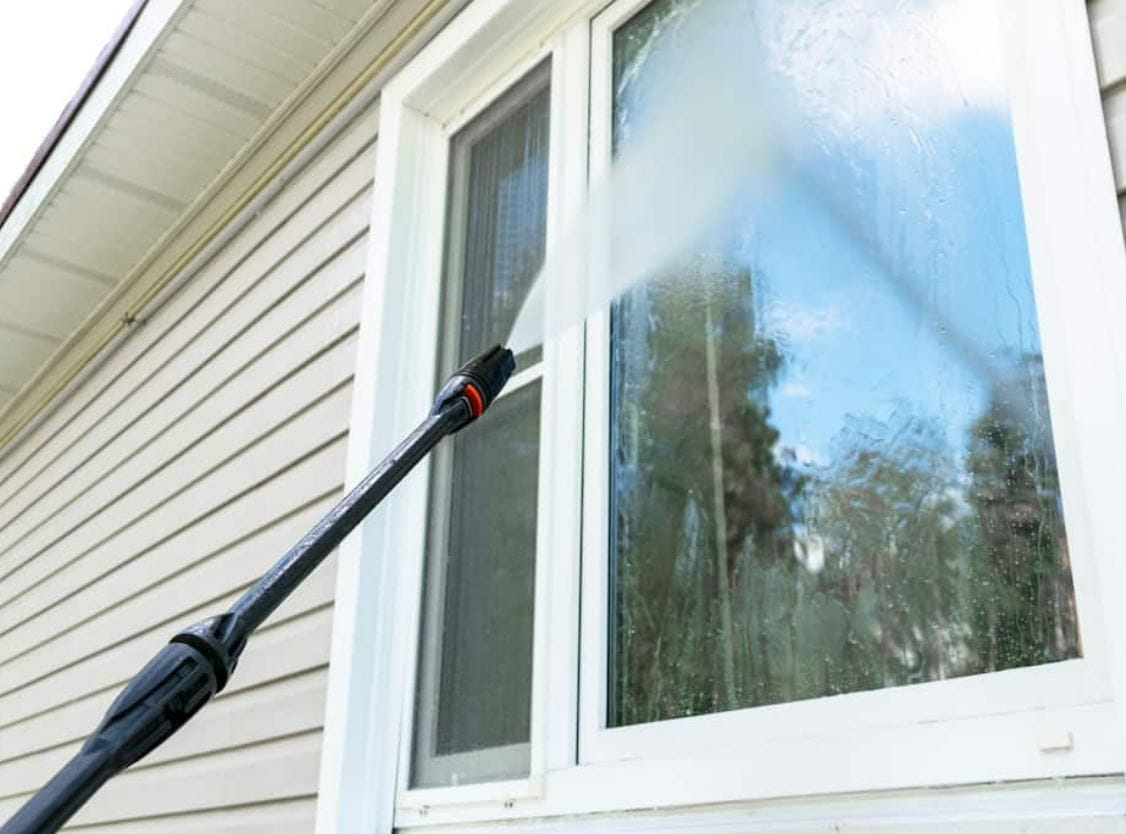
Using a pressure washer to clean windows is a high-risk, high-reward technique. When executed correctly, it eliminates toxic chemicals, reduces scrubbing time, and reaches second-story glass without a ladder. When done wrong, it etches glass, destroys seals, and turns window cleaning into a costly replacement project.
This guide provides a data-driven methodology to clean windows safely and effectively using a power washer.
Critical Risk Assessment: Should You Use a Power Washer?
Before reviewing the technique, evaluate your equipment. Not all pressure washers are suitable.
| Feature | Safe for Windows | Unsafe for Windows |
|---|---|---|
| Pressure (PSI) | 600–1,200 PSI | Above 1,500 PSI |
| Flow Rate (GPM) | 1.2 – 1.8 GPM | > 2.0 GPM |
| Nozzle Type | 40° white soap nozzle or wide fan (65°+) | 0° red (jet), 15° yellow, turbo nozzle |
| Distance from Glass | 18–36 inches | < 12 inches |
| Detergent | Biodegradable, non-abrasive window wash | Acidic or butyl-based degreasers |
Warning: Never use a turbo nozzle or rotary nozzle on glass. The oscillating jet creates micro-fractures invisible to the eye, leading to spontaneous shattering weeks later.
Required Equipment
- Pressure washer (electric preferred for lower PSI)
- 40° white nozzle (or dedicated window-cleaning nozzle)
- Downstream injector or foam cannon (for soap)
- Telescoping wand (for second-story windows)
- Squeegee with rubber blade (final finishing)
- Microfiber towels (lint-free)
- Plastic sheeting (to protect siding and frames)
Step-by-Step Procedure
Step 1: Preliminary Inspection
Check each window for:
- Cracks or chips – Do not power wash; replace glass first.
- Broken seals – Fogging between panes means failed seals; power washing will force moisture inside.
- Peeling frames – Wood or painted frames require hand-cleaning only.
Step 2: Surface Preparation
- Close all windows completely. Lock them to prevent water ingress.
- Cover adjacent surfaces: electrical outlets, light fixtures, and wooden doors.
- Rinse loose dirt from window frames using the 40° nozzle at 3+ feet.
Step 3: Soap Application (Low Pressure)
Apply detergent at low pressure (under 500 PSI) using a downstream injector or foam cannon.
| Detergent Type | pH Level | Window Suitability |
|---|---|---|
| Dedicated window wash | 7–8 (neutral) | Excellent |
| Car wash soap (pH-neutral) | 7–7.5 | Good |
| Household dish soap (diluted) | 8–9 | Fair (rinses poorly) |
| Bleach or ammonia-based | 11+ | Never use |
Allow detergent to dwell for 3–5 minutes but do not let it dry on glass.
Step 4: Rinsing Technique (Critical Phase)
- Switch to the 40° white nozzle.
- Stand at an 18–24 inch distance from the glass.
- Hold the lance at a 45-degree downward angle (never perpendicular).
- Rinse from top to bottom with overlapping horizontal passes.
- Keep the spray cone fully on the glass—half on the frame and half on glass causes edge streaking.
Step 5: Final Squeegee Pass (Non-Negotiable)
Power washing alone will never deliver streak-free windows. Residual water contains minerals that form hard water spots.
Immediately after rinsing:
- Wet a squeegee blade with a few drops of rinse aid (or white vinegar solution).
- Wipe from top corner, pulling straight down in a single continuous stroke.
- Wipe blade clean after each pass.
Common Mistakes & Fixes
| Mistake | Consequence | Solution |
|---|---|---|
| Using 15° or 25° nozzle | Glass etching or shattering | Replace with 40° nozzle |
| Washing in direct sunlight | Soap dries, leaving chemical stains | Work on cloudy days or shaded side |
| Spraying bottom edges upward | Water forced behind weatherstripping | Always spray top-to-bottom |
| Skipping the squeegee | Permanent mineral spotting | Always use rubber squeegee |
Comparison: Power Washing vs. Traditional Window Cleaning
| Factor | Power Washer | Squeegee + Bucket |
|---|---|---|
| Speed (per 10 windows) | 15–20 minutes | 30–45 minutes |
| Water usage | 2–3 gallons | 5–7 gallons |
| Reach (2-story) | Yes (telescoping wand) | No (ladder required) |
| Risk of damage | Moderate–High | Very Low |
| Streak-free guarantee | Only with squeegee | Yes (directly) |
| Chemical exposure | Low | Low to moderate |
Professional Recommendation
For annual deep cleaning of exterior windows in good condition, a low-PSI (1,000–1,200) electric pressure washer with a 40° nozzle is highly effective, provided you finish with a squeegee.
However, for historic, tinted, or thermopane windows, avoid pressure washing entirely. The thermal stress and micro-abrasion risk outweigh any time savings.
Final Verdict: Power washing cleans windows faster but requires strict nozzle discipline and a manual squeegee pass to achieve professional results. Without the squeegee, you are simply spraying dirty water onto glass.
SEO Keywords Integrated
- how to clean windows with a power washer
- pressure washer window cleaning technique
- best PSI for washing windows
- window cleaning nozzle guide
- power wash glass without streaks