Can You Use Glass Cleaner on Mirrors? A Professional Guide to Streak-Free, Damage-Free Results
The short answer is yes—but with one critical caveat. You can use glass cleaner on mirrors, provided you choose an ammonia-free formula. Standard ammonia-based glass cleaners are excellent for windows, but they pose a long-term risk to the delicate reflective backing of mirrors, potentially causing irreversible “desilvering” or black edge damage . For a pristine, professional finish, the product is only half the equation; the tools and technique you use are equally important for preventing streaks and protecting the mirror’s integrity.
The Chemistry of Mirrors: Why Ammonia Matters
A mirror is not simply a piece of glass. It consists of a glass pane with a thin reflective metal coating (typically silver or aluminum) applied to the back, which is then protected by a backing layer . Ammonia, a common ingredient in many commercial glass cleaners, is a highly effective solvent for cutting grease. However, when it seeps into the edges of a mirror, it can corrode the protective backing and the reflective metal layer over time . This degradation manifests as dark, cloudy spots or “desilvering” along the edges that cannot be polished away.
Therefore, the first rule of mirror care is to read the label. Look for cleaners explicitly labeled “ammonia-free” or safe for mirrors. Many popular brands like Sprayway are ammonia-free and widely recommended by cleaning professionals for this exact reason .
Glass Cleaner vs. Homemade Solutions: A Comparison
While commercial ammonia-free glass cleaners are convenient and effective, many professionals and home experts prefer DIY solutions for their low cost and controllable ingredients. The table below compares the most common options.
The Professional Technique: Tools and Motion
Even the best cleaner will fail if applied with the wrong tools or motion. Experts from the Good Housekeeping Institute and professional cleaning services consistently highlight two critical errors: using paper towels and wiping in circles.
1. The Right Tool: Microfiber is Non-Negotiable
Paper towels are the enemy of a streak-free mirror. They shed lint and fibers that cling to the glass, creating a hazy appearance . Rags and sponges can also leave residue. The professional standard is a clean, flat-weave microfiber cloth. Microfiber is highly absorbent, lifts dirt without scratching, and leaves virtually no lint behind . For the final polish, a second, dry microfiber cloth is essential to buff away any remaining moisture .
2. The Right Motion: The “S” Pattern
Circular wiping is a common mistake. It generates static electricity, which actually attracts dust to the surface you just cleaned . The correct technique is to wipe in an “S” pattern (or overlapping horizontal strokes), starting from the top of the mirror and working your way down. This ensures even coverage, prevents drips from running down the clean surface, and avoids the static buildup that circular motions create .
3. The Application: Spray the Cloth, Not the Mirror
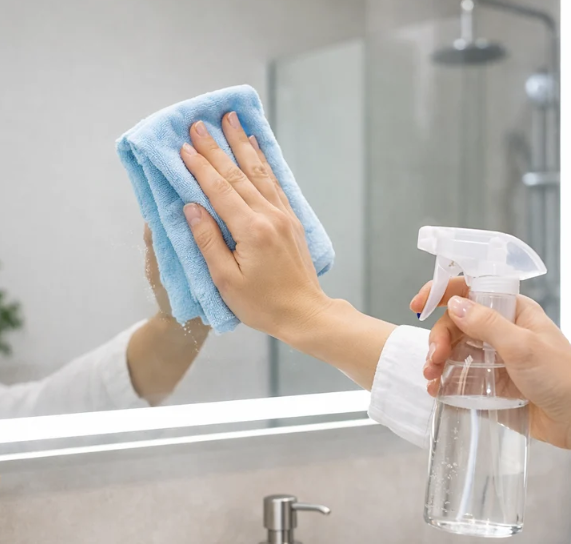
While some experts advocate spraying the mirror directly for full coverage, many caution against it. Spraying directly can cause liquid to drip down into the frame, where it can seep behind the glass and damage the backing . A safer, more controlled method is to spray the cleaner onto your microfiber cloth until it is lightly damp, then wipe the mirror. This prevents drips, avoids over-saturating the edges, and gives you more control over the cleaning process .
Frequently Asked Questions (FAQs)
1. Can I use Windex or a similar blue glass cleaner on my mirror?
It depends on the specific formula. Traditional Windex with Ammonia-D is generally not recommended for repeated use on mirrors because the ammonia can degrade the reflective backing over time . However, Windex and similar brands offer ammonia-free versions (often labeled “Vinegar” or “Ammonia-Free”) that are safe for mirrors. Always check the label for the words “ammonia-free” before use.
2. Why does my mirror look streaky immediately after I clean it?
Streaks are typically caused by one of three factors: using a paper towel or a dirty cloth that leaves lint/residue ; using too much cleaner, which evaporates unevenly ; or failing to buff the surface dry with a second, clean microfiber cloth . Ensure you are using a two-cloth system: one damp for cleaning, one dry for polishing.
3. How do I clean the black spots around the edge of my mirror?
The black spots are likely “desilvering”—corrosion of the reflective backing that has already occurred, often accelerated by moisture or ammonia exposure . Unfortunately, this is usually permanent damage that cannot be cleaned away. To prevent further spread, ensure you are not spraying liquid directly on the mirror (which can drip into the edges) and switch to an ammonia-free cleaner immediately .
4. Is it safe to use vinegar on a mirror?
Yes, a 50/50 mixture of distilled white vinegar and water is a safe and effective natural cleaner for mirrors . The mild acidity cuts through water spots and light grime without the harsh corrosiveness of ammonia. However, avoid using vinegar on natural stone frames or surfaces, as the acid can etch the stone.
5. How often should I clean my bathroom mirror versus a decorative mirror?
Bathroom mirrors require significantly more frequent attention. Cleaning professionals recommend wiping down a bathroom mirror at least once a week—and up to twice a week in high-traffic bathrooms—due to constant exposure to toothpaste splatter, soap scum, and hairspray . Decorative mirrors in living areas or bedrooms that do not face moisture or splatter can be cleaned every three to five weeks .