10 High-Touch Areas in Offices That Need Daily Cleaning
Quick Answer
High-touch surface cleaning targets the ten office zones where hands transfer the most microbial load each day: door handles, shared keyboards, elevator buttons, light switches, kitchen taps, washroom fixtures, reception counters, meeting room controls, vending pads, and printer panels. A sound protocol applies an EPA-registered disinfectant with the correct dwell time, uses colour-coded microfibre cloths, and follows a low-to-high contamination sequence.
Introduction
Facility managers across the local market keep running into the same problem. Cold and flu absenteeism climbs every quarter, sick days quietly drain productivity, and a dusty reception counter chips away at how clients perceive the brand.
Frontline teams need clarity on which hotspots demand attention each shift, which chemistries play well with electronics, fabric, and metal finishes, and how long an agent must stay wet on a surface to actually work. Operators who want to benchmark their current programme against industry standards can learn more about evidence-based janitorial methods and audit frameworks.
Beyond the basics, the gap between a simple list and a real sanitation system lies in sequencing, training, and verification.
Why Daily Hygiene Defines a Healthy Workplace
A modern office is essentially a shared microbial environment. Every handle, button, and shared device acts as a vector for bacterial and viral transfer, which is why facility teams now treat sanitation as a measurable engineering discipline rather than a janitorial afterthought.
The technical baseline comes from organizations such as the CDC, Health Canada, and ISSA, all of which separate cleaning, sanitizing, and disinfecting into three distinct operational steps with different outcomes.
The Science of Pathogen Transfer
Microbes move through a workspace by direct hand contact, aerosolized droplets, and fomite transmission, the technical term for indirect transfer through inanimate objects. Studies in the American Journal of Infection Control show that contamination from one inoculated point can reach 40 to 60 percent of touchpoints within two to four hours of normal occupancy. The result is a compounding bioburden that easily outpaces infrequent sanitation cycles.
Cleaning Versus Office Disinfecting
The two terms get used interchangeably, yet they describe different mechanical and chemical actions. Cleaning lifts visible soil and biofilm using detergents and friction, while disinfecting kills residual organisms with a registered chemical agent. A surface cannot be properly disinfected until it has first been cleaned, because organic matter neutralizes most active ingredients.
Measuring What You Cannot See
Visual checks are unreliable for verifying sanitation performance, so professional operators rely on objective metrics:
- ATP bioluminescence meters that quantify organic residue in relative light units (RLU)
- Contact agar plates for colony-forming unit (CFU) counts at critical points
- Fluorescent marker audits that confirm whether high-frequency zones were physically wiped
- Digital inspection logs tied to checklist completion timestamps
These methods turn workplace cleaning from a subjective task into an auditable process, matching the standard already applied in healthcare and food service.
The Ten Office Hotspots and How to Clean Them Correctly
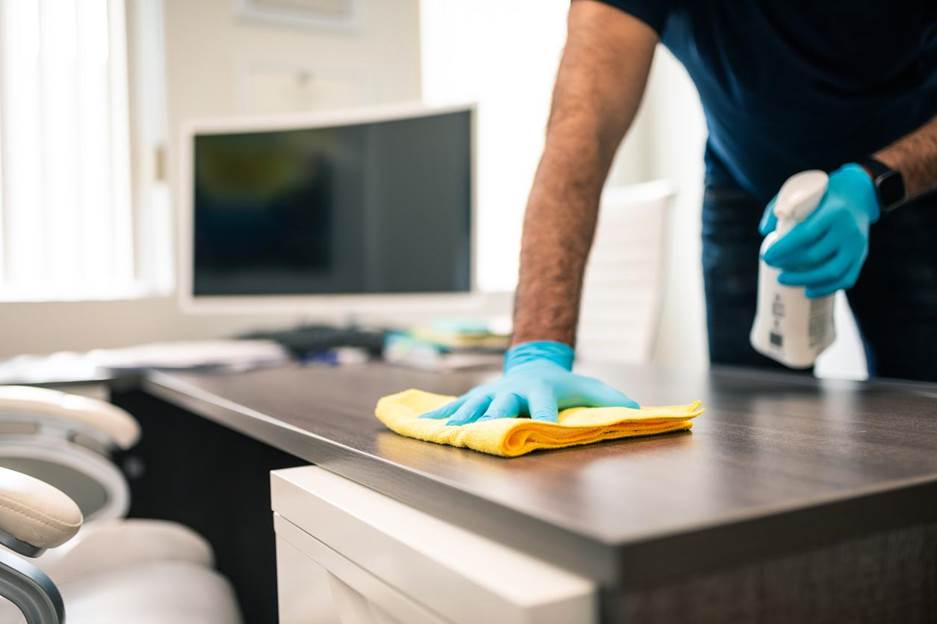
Not every surface carries the same risk profile. Bioburden studies repeatedly show that a small group of contact points drives the bulk of microbial transfer in any commercial space, which is where professional crews concentrate their effort.
The Ten Daily Priority Zones
A defensible daily office cleaning checklist should cover these ten zones every shift:
- Door handles, push plates, and access card readers
- Shared keyboards, mice, and conference room remotes
- Elevator buttons and stair handrails
- Light switches and thermostat controls
- Kitchen taps, fridge handles, and microwave panels
- Washroom fixtures, dispensers, and stall latches
- Reception counters, sign-in tablets, and shared pens
- Meeting room tables, AV controls, and phone consoles
- Vending machine keypads and water cooler levers
- Printer touchscreens, copier panels, and supply cabinet pulls
Matching Chemistry to Surface
Material compatibility matters as much as kill claim. Quaternary ammonium products can cloud polycarbonate screens, while hydrogen-peroxide formulations are gentler on electronics yet need a shorter wet window.
| Disinfectant Class | Typical Dwell Time | Best Use | Material Risk |
| Quaternary Ammonium | 5 to 10 minutes | Hard floors, washrooms | Streaks glass, dulls some plastics |
| Hydrogen Peroxide (AHP) | 1 to 5 minutes | Electronics, desks, fabric-adjacent zones | Low, residue-free |
| Sodium Hypochlorite | 1 to 10 minutes | Heavy contamination, washroom porcelain | Corrodes metal, bleaches fabric |
| Alcohol (70 percent) | 30 seconds to 1 minute | Small electronics, screens | Flammable, fast evaporation |
Disciplined product pairing and zone sequencing turn touchpoint cleaning from routine wiping into a measurable hygiene control.
Building a Programme That Holds Up Over Time
A protocol is only as strong as the system that keeps it alive. Forward-thinking facility teams now run sanitation as a documented programme with training, auditing, and review cycles baked in, rather than a static task sheet pinned to a supply closet wall.
Standardizing the Operational Backbone
Long-term performance rests on three pillars that reinforce each other:
- Written procedures for every zone, covering chemistry, dwell time, and colour-coded cloth assignment
- Recurring staff training with refresher modules every six months and structured onboarding for new hires
- Verification audits that combine ATP testing, fluorescent marker checks, and digital completion logs
Integrating Technology and Reporting
Modern facility software has reshaped how operators prove performance to stakeholders. Cloud-based checklist platforms timestamp each completion, flag missed zones in real time, and generate monthly compliance reports that satisfy occupational health requirements. In practice, this data trail also supports insurance reviews and tenant retention conversations, because measurable hygiene metrics now sway commercial lease decisions across the region.
Treating high touch surface cleaning as a continuous improvement discipline, supported by verification data and trained staff, is what separates a reactive janitorial routine from a workplace health strategy that genuinely protects people.
Key Takeaways for a Cleaner, Safer Workspace
Sanitation performance comes down to three disciplines: knowing which zones carry real microbial risk, matching the right chemistry to each surface, and verifying results with objective data rather than visual checks. Teams that document procedures, train crews regularly, and audit unpredictably outperform those relying on routine alone.
When approached as an engineered system rather than a checklist, high-touch surface cleaning protects occupant health, supports compliance, and reinforces the operational credibility of any modern facility.