Do Meteorites Rust? The Definitive Guide to Space Rock Oxidation
When a rock from space lands in your backyard, the first image that often comes to mind is a shimmering, metallic object like something from a science fiction film. The reality is far more complex and chemically dynamic. One of the most common questions asked by new meteorite hunters and collectors is a deceptively simple one: Do meteorites rust?
The short answer is yes, absolutely—but not all of them, and not in the way a rusty nail does. The process is a constant battle between preservation and terrestrial chemistry. This article provides a deep dive into the oxidation of meteorites, covering why iron meteorites are prone to “lawrencite disease,” why some stony meteorites don’t rust, and how scientists and collectors fight to preserve these ancient messengers of the solar system.
1. The Two Worlds of Meteoritic Rust
To understand rust, you must first understand the fundamental classification of meteorites. “Rust” is iron oxide (Fe₂O₃ or FeO(OH)), meaning the meteorite must contain metallic iron to oxidize. This splits the meteorite world into two distinct camps regarding rust susceptibility.
| Feature | Iron Meteorites & Pallasites | Stony (Chondrite/Achondrite) Meteorites |
|---|---|---|
| Iron Content | Primarily metallic iron-nickel (Fe-Ni) alloy (kamacite, taenite). | Mostly silicates (olivine, pyroxene). Often contains disseminated Fe-Ni metal flecks. |
| Rust Behavior | Highly prone to catastrophic rusting. Can actively “weep” ferric chloride. | Slow, surface-level oxidation on exposed metal grains only. Silicates do not rust. |
| Primary Threat | Lawrencite Disease (fast-acting, electrochemical corrosion). | Hydration and expansion of veins, but rarely systemic structural failure. |
| Necessary Condition | Requires moisture and chloride contamination. | Requires acidic moisture or prolonged burial. |
2. Iron Meteorites: The Threat of Lawrencite Disease
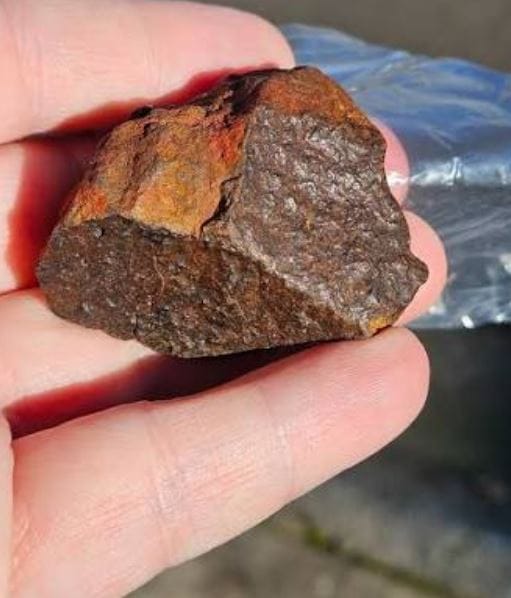
If you handle a Campo del Cielo or Muonionalusta meteorite, you may notice bright orange droplets forming on its surface over time, a phenomenon known colloquially as “sweating.” This is not simple rust. It is an aggressive, autocatalytic process specific to meteorites called Lawrencite Disease.
2.1 The Chemical Culprit: Lawrencite
The villain is the mineral lawrencite, specifically ferrous chloride (FeCl₂). Many iron meteorites contain microscopic inclusions of this mineral, formed in the absence of water during their parent body’s cooling over 4.5 billion years. Lawrencite is perfectly stable in the vacuum of space. However, upon Earth’s arrival, it becomes hygroscopic, extracting moisture from the air.
2.2 The Autocatalytic Cycle of Destruction
Once moisture contacts lawrencite, a vicious cycle begins:
- Hydration: FeCl₂ absorbs water to form a hydrated salt.
- Hydrolysis & Oxidation: The water reacts with the chloride, releasing hydrochloric acid (HCl) and forming iron oxy-hydroxides (akaganéite).
- Acid Attack: The free HCl immediately attacks the surrounding metallic iron (kamacite), creating more ferrous chloride (FeCl₂).
- Propagation: The newly formed FeCl₂ absorbs more moisture, starting the cycle again.
Because the reaction regenerates the chloride reactant, a single microscopic grain of lawrencite can eventually consume an entire iron meteorite, turning it into a pile of brown dust.
Expert Insight: “The presence of chlorine is what distinguishes meteoritic rust from terrestrial rust. Iron meteorites are essentially a battery where the electrolyte is hydrochloric acid, constantly regenerating itself.”
— Dr. Laurence Garvie, Center for Meteorite Studies, ASU
2.3 Visual Diagnosis
Meteorite oxidation progresses through specific chromatic stages:
- Stage 0: Freshly cut metallic silver, mirror-like (rare in finds).
- Stage 1: Blue-black magnetite patina (stable).
- Stage 2: Bronze/brown discoloration (unstable).
- Stage 3: Active orange droplets (FeCl₃ liquid).
- Stage 4: Greenish-yellow crust (high acidity, advanced decay).
- Stage 5: Crumbling black/brown spallation.
3. The Protective Role of Rust: Fusion Crust vs. Lawrencite
There is a critical distinction to be made between destructive oxidation and protective oxidation.
Terrestrial Age and Weathering Scale
Scientists use a specific scale for meteorite finds in places like Antarctica or hot deserts. While “rust” is generally bad, the natural weathering grade determines a specimen’s scientific and monetary value.
| Weathering Grade | Description | Visual Characteristics |
|---|---|---|
| W0 | Fresh, unweathered fall. | No visible oxidation. Fusion crust intact. |
| W1 | Minor oxidation. | Thin halos of oxide around metal grains. |
| W2 | Moderate oxidation. | Metal heavily oxidized, but silicates unchanged. |
| W3 | Heavy oxidation. | Metal completely replaced by oxides. Silicates stained. |
| W4 | Extensive terrestrialization. | Stony meteorite is mostly hydrated minerals and rust. |
| W5 | Trace elements only. | A ghost of the original rock; heavily leached. |
| W6 | Residual mass. | Massive replacement by clay-like minerals and oxides. |
A meteorite classified as W0 is often a “fall” (witnessed and recovered immediately), while a W4 was found in a damp forest after centuries. The fusion crust itself is a form of pre-terrestrial oxidation—magnetite (Fe₃O₄) formed during atmospheric entry—which acts as a passivation layer that prevents deeper rust for a short period.
4. Stony Meteorites: When Rocks Do Rust
Ordinary chondrites (H, L, LL groups) contain between 5% and 30% metallic iron-nickel interspersed as tiny grains among silicate chondrules.
4.1 The Weathering Pattern
In a humid climate, a stony meteorite will not rust uniformly like an iron bar. Instead, it develops a “shock-brecciated” rust pattern. Moisture percolates through micro-fractures in the silicates, targeting the metal grains. The oxidized metal expands in volume by a factor of three, exerting mechanical pressure that shatters the stone from the inside out. This is why many ancient finds disintegrate upon drying.
4.2 The Exception: Carbonaceous Chondrites
Carbonaceous chondrites (like Allende or Murchison) contain minimal to no free metallic iron. Their iron is locked within silicate lattices (olivine) or sulfides. Consequently, these meteorites do not rust in the traditional orange/brown sense. However, they are vulnerable to hydration of their clay minerals and oxidation of organic compounds, which can still alter their pristine solar chemistry.
5. Preservation and Treatment: Stopping the Rust
The conservation of meteorites is a highly specialized field, distinct from antique tool restoration. The goal is not just to coat the metal, but to extract chloride ions.
5.1 The Anhydrous Ethanol Bath
The industry standard for treating newly found iron meteorites or unstable specimens involves submerging the meteorite in absolute (200 proof) ethanol. The ethanol acts as a solvent for water, drawing residual moisture out of the rock’s capillaries. This is usually done for weeks, with the ethanol changed regularly until it stops turning yellow.
5.2 Alkaline Chloride Extraction (Sulfite Method)
For severely infected meteorites, a chemical reduction is necessary. The specimen is placed in a solution of sodium sulfite and sodium hydroxide. This high-pH environment converts insoluble ferric oxyhydroxides into soluble compounds and aggressively strips chlorine from the lattice of akaganéite.
5.3 Protective Coatings
| Coating Type | Pros | Cons | Best Used For |
|---|---|---|---|
| Microcrystalline Wax (Renaissance Wax) | Reversible, pH neutral, museum standard. | Not a moisture barrier; soft. | Display specimens in controlled environments. |
| Clear Lacquer/Enamel | Strong moisture barrier. | Can trap moisture if applied poorly; irreversible; yellows with time. | Campo del Cielo crystals sold commercially. |
| Tannic Acid Conversion | Converts red rust (Fe₂O₃) to stable blue-black ferric tannate. | Darkens the specimen; cosmetic change. | Slices with visible Widmanstätten patterns. |
| Silica Gel/Desiccant Storage | Zero chemical change; no contact. | Only works while sealed; high maintenance. | Scientific research collections (e.g., NASA, Smithsonian). |
| Vapor Phase Corrosion Inhibitors (VpCI) | Volatile molecules that coat internal channels. | Long-term toxicity/de-gassing concerns in sealed cases. | Long-term storage in safes. |
6. Frequently Asked Questions (FAQ)
Q: Does a rusty meteorite lose its magnetic properties?
A: The ferromagnetic nickel-iron (kamacite) is what attracts a magnet. When it oxidizes into non-magnetic hematite or magnetite, the bulk attraction strength decreases. A fully “lawrencite-ized” meteorite will leave a magnetic brown stain but won’t hold a strong pull.
Q: Why do some meteorites rust faster in my house than in the ground?
A: Paradoxically, some meteorites reach equilibrium with the soil chemistry where they land. Digging them up introduces a new oxygen and humidity shock. The rapid change from an anoxic burial environment to ambient air triggers the aggressive oxidation front.
Q: Is meteorite rust toxic?
A: Standard rust is iron oxide and harmless. However, the green liquid produced by active lawrencite disease is acidic and contains heavy metals like nickel and cobalt, which can cause skin irritation. Always wear gloves when handling actively “weeping” specimens.
Q: Can I use WD-40 or gun oil on my meteorite?
A: Absolutely not. Petroleum-based oils contain sulfur compounds and moisture that accelerate chloride reactions. They penetrate the crystal boundaries of the meteorite and are virtually impossible to remove, ruining the specimen for scientific analysis.
7. Conclusion: A Race Against Earth’s Chemistry
Meteorites do rust, and their rust is a window into the hostility between Earth’s oxygen-rich, water-soaked environment and the pristine chemistry of space. While a stony meteorite may survive millennia as a stable, oxidized nodule, an iron meteorite is in a constant chemical war with our atmosphere.
For the collector, the “rusty meteorite” is a paradox: the patina proves its extraterrestrial origin and antiquity, yet the orange bloom of lawrencite signals its impending doom. Proper preservation requires science, not just cosmetics, turning back the clock on a chemical reaction that began the moment the rock fell from the sky.