Aphids on Japanese Maple: A Comprehensive Management Guide for 2026
Periphyllus californiensis, commonly known as the California maple aphid, represents the primary aphid species affecting Japanese maples (Acer palmatum) worldwide. While these diminutive insects rarely cause fatal damage to established specimens, their feeding activity can compromise tree aesthetics and vigor through leaf distortion, honeydew production, and sooty mold development. This guide provides arborists, landscape professionals, and home gardeners with evidence-based strategies for identification, monitoring, and management.
Identification and Life Cycle
Species Recognition
The California maple aphid belongs to the Periphyllus genus, a group of aphids specifically adapted to maple hosts. Unlike generalist aphids, P. californiensis has evolved a complex life cycle synchronized with the phenological development of Japanese maples.
Key morphological features include:
- Nymphs: Small white or pale dots colonizing leaf undersides
- Winged forms (alates): Leggy individuals with functional wings for dispersal
- Coloration: Variable, often with distinctive abdominal cross-bands
Complex Life Cycle and Seasonal Dynamics
The life cycle of P. californiensis demonstrates remarkable adaptation to host tree phenology, with populations exhibiting two distinct annual peaks and seasonal habitat shifts within the tree architecture.
Early Spring (March-April): Stem mothers hatch from overwintered eggs before host budding. Larvae initially colonize buds and young shoots, where soluble nitrogen concentrations are highest.
Mid-Spring Dispersal (April-May): Winged aphids disperse to suitable host trees. The population reproduces actively, producing “aestivating dimorphs”—a specialized summer form triggered by changing leaf nutritional conditions.
Summer Dormancy: Aestivating dimorphs enter a quiescent state with exceptionally high mortality rates, often eliminating entire populations on individual trees.
Autumn Revival (October-November): Aestivating forms molt in mid-October. Winged aphids reappear in November, producing wingless females that deposit overwintering eggs, primarily in December.
Micro-habitat Specialization: Throughout the year, the aphid shifts between tree parts: buds and shoots in spring, inflorescences and key fruits through late spring and summer, and leaves in autumn—suggesting that only specific seasonal micro-habitats support optimal development.
Factors Influencing Population Development
Temperature: Development accelerates with warmth—winged aphids complete development in 10 days at 17°C in controlled conditions. Cool spring weather creates favorable conditions for population build-up.
Budding Phenology: Population success depends on precise synchronization between stem mother hatching and host budding. Stem mothers hatching after budding cannot produce larvae with sufficient food availability. Trees with earlier budding support initial population development, while winged females disperse to later-budding trees for additional reproductive opportunities.
Shading Effects: Shaded maples bud earlier and retain leaves later than sun-exposed trees. This variation enables winged aphids emerging on shaded trees to find suitable late-budding hosts. Autumn egg-laying predominantly occurs on shaded trees with yellow foliage.
Damage Assessment
Direct Feeding Damage
Aphids feed by penetrating phloem ducts with their needle-like mouthparts and extracting nutrient-rich sap. High population densities cause:
- Leaf curling and distortion that persists permanently, even after aphid removal
- Stunted shoot growth in heavy infestations
- Chlorosis from sap removal reducing photosynthetic capacity
Honeydew and Sooty Mold
Honeydew—a clear, sticky, sugary liquid excreted by sap-feeding insects—represents the most conspicuous symptom of infestation. This substance:
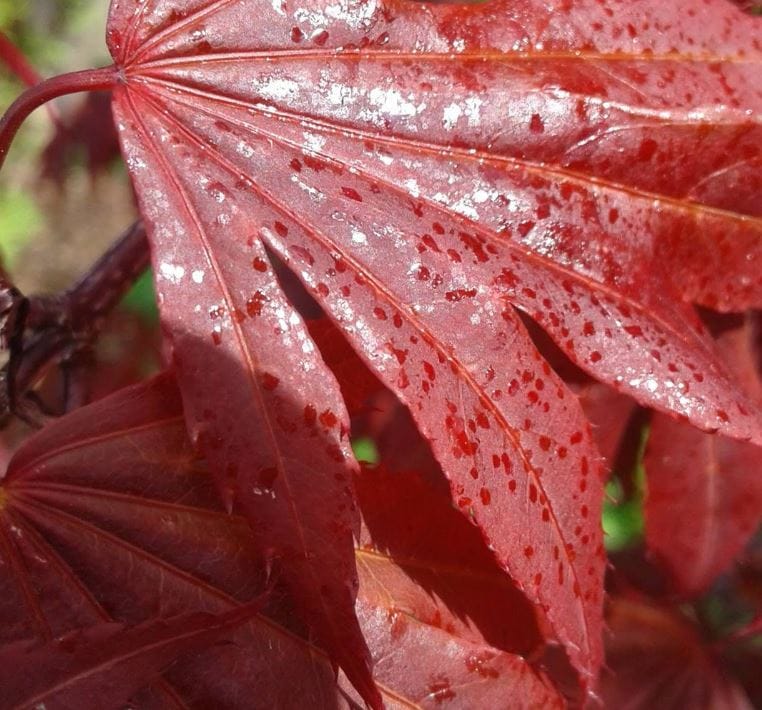
- Coats leaves, creating a wet or shiny appearance
- Drips onto understory plants, vehicles, and hardscapes
- Serves as a substrate for sooty mold growth—a black, dusty fungal coating that reduces photosynthesis
While sooty mold does not kill the tree, it significantly detracts from the ornamental value of Japanese maples.
Long-term Implications
Established, healthy Japanese maples tolerate moderate aphid populations without lasting harm. Young or stressed trees, however, may experience vigor reduction from heavy, repeated infestations.
Integrated Pest Management (IPM) Approach
1. Biological Control: The Preferred Strategy
Natural enemies provide the most sustainable and effective control of aphid populations on Japanese maples, though there is typically a lag period between aphid population increase and predator response.
Primary Predators:
- Lady beetles (Coccinellidae): Adults and larvae are voracious aphid consumers. Lady beetle eggs appear as small yellow clusters on infested foliage. Larvae can eliminate nearly all aphids on a sample tree within days of their appearance.
- Hoverfly larvae (Syrphidae): Particularly Epistrophe balteata, these larvae consume large numbers of aphids in a short timeframe. Their mortality impact operates in a density-dependent manner, effectively regulating populations to lower levels.
- Parasitoid wasps: Lay eggs inside aphids, leading to death and providing long-term population suppression.
Encouraging Beneficial Insects: Plant marigolds, calendula, and other nectar-producing flowers to attract adult predators and parasitoids. Avoid broad-spectrum insecticides that harm these natural enemy populations.
Consultation: As one expert noted, “One consolation is that now that it has warmed up some, the natural enemies of the aphids will be more active against them”.
2. Physical Control: The Recommended First Response
High-Pressure Water Spray: The most effective non-chemical intervention involves directing a strong jet of water at infested leaf undersides. This treatment:
- Dislodges aphids, which fall to the ground waterlogged and unable to return
- Provides immediate population reduction without harming natural enemies
- Should be repeated as needed for emerging infestations
Practical Tip: For tall specimen trees, complete coverage becomes challenging. Focus on accessible lower and interior branches where practical.
Manual Removal: On small trees or limited infestations, running fingers along shoots and leaves crushes many aphids directly.
3. Chemical Control: Targeted Applications
When biological and physical controls prove insufficient, low-toxicity insecticides offer effective options with reduced environmental impact.
| Treatment Option | Application Method | Efficacy | Pollinator Impact | Residual Activity | Considerations |
|---|---|---|---|---|---|
| Insecticidal Soap | Foliar spray, targeted | Good against nymphs | Low (contact only) | Short (days) | Requires thorough coverage; may cause leaf burn on sensitive cultivars |
| Horticultural/Botanical Oil | Foliar spray, dormant or growing season | Good | Low | Short | Apply at labeled rates; avoid application during heat stress or drought |
| Imidacloprid (Systemic) | Soil drench or trunk injection | Excellent, long-lasting | High (systemic) | Long (months to years) | Not recommended as first-line treatment due to pollinator risks |
| Neem Oil | Foliar spray | Moderate | Low to moderate | Short | Multiple applications may be needed |
Insecticidal Soap: Recommended for small-scale infestations where water spray alone proves insufficient. Note that dish soap is not equivalent—commercial insecticidal soaps are formulated with specific fatty acid salts that are safer for plant foliage.
Systemic Insecticides: While products containing imidacloprid provide extended control, experts caution: “These products can be very harmful to pollinators when they get into flowering plants and are typically not our first recommendation”.
Application Timing: Treat early in the season while populations are still predominantly nymphs for maximum effectiveness. Consider that low-toxicity products break down quickly, requiring precise timing for adequate coverage.
Spray Coverage: For tall trees exceeding reachable height, application becomes problematic, and waiting for natural enemy activity may prove the most practical option.
Treatment Decision Matrix
| Condition | Recommended Action | Rationale |
|---|---|---|
| Low population, healthy tree | Monitor; no treatment | Natural enemies likely to provide control; cosmetic damage minimal |
| Moderate population, visible honeydew | High-pressure water spray; monitor for predators | Physical removal effective; preserves beneficial insects |
| Heavy population, leaf distortion, young/small tree | Insecticidal soap or horticultural oil; repeat as needed | Knock down population before damage accumulates; avoid systemics |
| Tall tree, severe infestation, no access | Consider systemic (imidacloprid) only as last resort | Application challenges; weigh pollinator risks against tree health needs |
| Active natural enemy presence | Cease treatment; allow predator activity | Biological control will regulate population more effectively than intervention |
Management Considerations and Outlook
Seasonal Patterns
Aphid populations typically peak in spring and autumn, with natural enemies providing regulation shortly after population build-up. Many infestations resolve without intervention as predator populations respond to food availability.
Weather Influence
Cool spring weather favors aphid reproduction, leading to more severe early-season infestations. Conversely, warm springs may accelerate predator activity and reduce the lag time between pest and beneficial insect population increases.
Cultivar Susceptibility
While Acer palmatum cultivars generally show similar susceptibility to P. californiensis, shaded trees experience different infestation patterns than sun-exposed specimens. This variation may influence management decisions in mixed landscape plantings.
Future Research Directions
Understanding the relationship between host tree phenology, shading, and aphid population dynamics continues to inform integrated management strategies. Research on the nutritional triggers for aestivating dimorph production may lead to more targeted preventive approaches.
Conclusion
Aphids on Japanese maple, particularly Periphyllus californiensis, represent a manageable pest challenge that generally resolves through natural biological control processes. The key to successful management lies in accurate identification, early monitoring, and the application of appropriate interventions based on infestation severity and tree condition. For most established trees, physical removal with water provides adequate control. When chemical intervention becomes necessary, preference should be given to low-toxicity, non-systemic options that preserve beneficial insect populations and minimize environmental impact.