The Complete Guide to Cleaning an Air Conditioner Drain Line
Introduction: Why This Neglected Pipe Matters
Your air conditioner does more than cool the air; it also dehumidifies it. As warm indoor air passes over the cold evaporator coil, moisture condenses out of the air, much like water forming on a glass of ice water. This condensate drips into a drain pan and then flows through a narrow pipe—typically a ¾-inch PVC line—to the outside of your home . When that drain line becomes clogged, the consequences range from reduced cooling efficiency to significant water damage to ceilings, walls, and floors .
Despite its critical role, the condensate drain line is one of the most frequently overlooked components of a residential HVAC system. This guide provides a comprehensive, professional-grade protocol for cleaning and maintaining your AC drain line, including comparisons of cleaning agents, troubleshooting steps, and preventive strategies.
Understanding the Clog: What Blocks an AC Drain Line
Before cleaning, it helps to understand what you are removing. AC drain line clogs are rarely caused by a single large object. Instead, they develop gradually through the accumulation of several substances:
- Algae and Mold: The dark, damp interior of a drain line is an ideal breeding ground for algae and mold, which form a thick, slimy biofilm that narrows the pipe’s diameter over time .
- Dirt and Dust: Airborne particles that bypass the filter settle in the moist line and combine with biological growth to form a sludge-like obstruction .
- Mineral Deposits: In systems with integrated humidifiers, the same drain line often handles winter runoff, leading to limescale and mineral buildup .
- Debris: Occasionally, insects, insulation fragments, or small particles enter the line and accelerate clogging .
The signs of a clogged drain line are usually unmistakable: standing water near the indoor air handler, musty odors from vents, water stains on ceilings or floors, or a system that shuts down entirely due to a triggered safety float switch .
Step-by-Step Cleaning Protocol
Step 1: Safety and System Shutdown
Turn off the air conditioner at the thermostat and, for maximum safety, cut power to the indoor air handler at the breaker panel . This prevents the system from producing additional condensate while you work and eliminates the risk of electrical shock.
Step 2: Locate the Drain Line Access Point
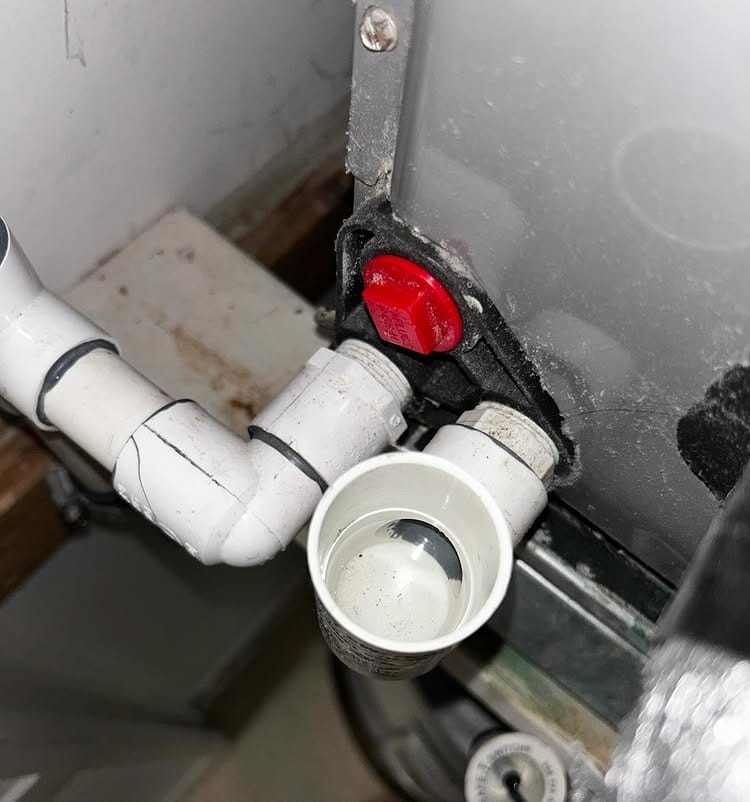
The drain line is typically a white or clear PVC pipe connected to the indoor air handler, which may be located in a basement, attic, closet, or crawlspace . Look for a T-shaped fitting or an uncapped vertical stub—this is your access point for cleaning and flushing.
Step 3: Clear the Immediate Blockage
If the line is visibly clogged, use a wet/dry vacuum to extract the obstruction. Remove the vacuum’s paper filter, connect the hose to the outdoor end of the drain line using duct tape or a tight cloth seal, and run the vacuum for several seconds to a few minutes until the clog is dislodged . Alternatively, a gloved finger or a slender implement can remove visible debris at the access point .
Step 4: Flush and Treat the Line
Once the blockage is cleared, flush the line with clean water to verify flow. Then apply a treatment agent (see the comparison table below) through the access point, allow it to dwell for the recommended time, and flush again with water. Verify that water flows freely at the outdoor discharge point .
Step 5: Prevent Recurrence
Cleaning is only half the battle. Regular maintenance—monthly or bi-monthly inspections during cooling season—is the most reliable way to prevent clogs from recurring . Consider installing a safety float switch if your system lacks one, and schedule annual professional HVAC maintenance to address issues beyond the drain line .
Comparison of Drain Line Cleaning Agents
Not all cleaning solutions are appropriate for every system. The table below compares the most commonly recommended agents across key criteria.
Important caveat: Some newer AC units explicitly advise against bleach or vinegar due to oxidation and material degradation concerns. Always consult your system’s manual before introducing any chemical agent . When in doubt, hot water and mechanical clearing are the safest defaults.
Troubleshooting Persistent or Recurring Clogs
If water still backs up after flushing, or if clogs return within weeks, the issue may extend beyond simple biofilm accumulation. Consider the following possibilities:
- Improper drain line slope: The pipe must pitch downward continuously toward the discharge point. A sagging section or incorrect installation can trap water and accelerate buildup .
- Frozen evaporator coil: If the coil is frozen due to low refrigerant or restricted airflow, the resulting meltwater may overwhelm the drain system. Check for ice on the indoor coil and address underlying refrigeration or airflow issues .
- Disconnected or damaged pipe: A loose fitting or cracked section can leak before water reaches the discharge point, mimicking a clog .
- Deep obstruction: A clog that resists vacuuming and flushing may require professional hydro-jetting or mechanical augering by an HVAC technician.
When to Call a Professional
While routine drain line cleaning is well within the capabilities of most homeowners, certain situations warrant professional intervention. Call a licensed HVAC technician if: the system has shut down due to a safety switch and does not restart after clearing the line; water damage has already occurred; clogs recur frequently despite regular maintenance; or you are uncomfortable working near the air handler’s electrical components. Professionals also have access to specialized tools—such as condensate pumps and line-clearing augers—that are not part of a typical homeowner’s toolkit .
Frequently Asked Questions
How often should I clean my AC drain line?
For most systems, a monthly or bi-monthly flush during the cooling season is sufficient to prevent significant buildup . If you use a chemical or biological treatment, follow the product’s recommended interval—typically every one to three months for vinegar-based maintenance . Systems in high-humidity climates or those with integrated humidifiers may require more frequent attention.
Can I use bleach to clean my AC drain line?
Bleach is effective at killing mold and algae, but its use is increasingly debated. It can corrode the aluminum evaporator coil and other metal components if it backs up into the air handler, and some manufacturers explicitly prohibit it . If you choose to use bleach, dilute it—common recommendations range from one part bleach to ten parts water, or a 50/50 mixture—and pour it only into the drain line access point, never directly onto the coil. White vinegar is a safer routine alternative for most systems .
What should I do if water is leaking from my AC but the drain line seems clear?
If the drain line flows freely but water still appears, the problem may lie elsewhere. Check whether the evaporator coil is frozen (indicating low refrigerant or airflow restriction), inspect the drain pan for cracks or misalignment, and verify that the emergency drain line (if equipped) is not the source of the water . A float switch may have tripped and shut down the system; if the pan is dry and the line is clear but the system will not run, the switch itself may require resetting or replacement. In these cases, professional diagnosis is recommended.
By treating the condensate drain line as a routine maintenance item rather than an afterthought, homeowners can avoid the most common—and most preventable—cause of AC water damage and system shutdowns. A few minutes every few months, paired with annual professional service, will keep condensate flowing where it belongs: outside your home, not through your ceiling.