Do Black Stainless Steel Sinks Scratch? The Unvarnished Truth About Durability
The allure of a black stainless steel sink is undeniable. It makes a bold, sophisticated statement in a modern kitchen, offering a striking contrast to lighter countertops and hiding water spots far better than its classic silver counterpart. However, before making this significant design investment, a critical question looms in the mind of every discerning homeowner: Do black stainless steel sinks scratch?
The short answer is yes, but the complete answer is far more nuanced. It is not a question of if a scratch can occur, but how easily, how visibly, and what can be done about it. This comprehensive guide dissects the material science, manufacturing processes, and real-world performance of black stainless steel sinks to provide you with an unvarnished, professional assessment.
The Core Technology: It’s Not Paint, It’s a Shield
To understand scratch resistance, you must first discard the misconception that the black color is a simple coat of paint. A high-quality black stainless steel sink derives its color and durability from a physical alteration of the steel’s surface at a molecular level. There are two predominant, high-end technologies:
- Physical Vapor Deposition (PVD): This is the gold standard. In a vacuum chamber, a solid material (typically a titanium-based compound) is vaporized and bonded to the stainless steel substrate at an atomic level. The result is not a coating that sits on top, but an integral, ultra-hard surface layer that is far harder than the underlying steel.
- Nano-Etching Technology: A less common but equally premium process where the surface of the steel is restructured with nano-scale pits and oxides to create a deep, light-absorbing black color. This finish is inherently the color of the metal itself, not an applied layer.
Less sophisticated, budget-friendly sinks rely on a polymeric or ceramic coating that is baked or sprayed onto the steel. This is fundamentally a paint-like layer and has a distinct bond line with the metal, making it dramatically more susceptible to chipping and scratching. The quality of your sink—and its resistance to damage—is almost entirely determined by this core technology.
PVD vs. Coated Sinks: A Definitive Scratch-Resistance Comparison
The difference in durability between a PVD sink and a coated sink is not marginal; it is categorical. The following table breaks down their performance characteristics.
| Feature | PVD / Nano-Etched Sink (Premium) | Coated / Lacquered Sink (Budget) |
|---|---|---|
| Hardness | Exceptionally high. PVD Titanium Nitride coatings can reach over 80 on the Rockwell C scale, significantly harder than the 304 stainless steel base (typically ~15-20 HRC). | Low to Moderate. The polymer or ceramic layer is inherently softer and more brittle than the steel substrate. |
| Bond Integrity | Atomic-level fusion. The coating becomes part of the metal, eliminating the risk of delamination or peeling. | Mechanical bond. There is a clear boundary layer where the coating adheres to the steel, a common point of failure leading to peeling. |
| Scratch Visibility | Low. Scratches are typically superficial marks in the top atomic layers of the PVD. The underlying steel is often a dark gunmetal or is also colored, so a scratch does not expose a stark, silver line. | High. A scratch easily cuts through the thin, dark coating to reveal the bright, silver stainless steel beneath. This high-contrast damage is visually jarring and irreparable. |
| Response to Abrasion | Resists fine abrasion from scouring pads. A “scratch” is often just a metal transfer from the pot that can be cleaned off. | Will be permanently dulled or scratched by even mildly abrasive cleaners. The coating’s gloss is easily compromised. |
| Long-Term Durability | Maintains integrity for decades. Resists chipping from impact and will not fade from UV exposure. | Has a defined service life. Prone to chipping, peeling, and fading, especially around the drain and high-wear areas. |
Professional Insight: A true “scratch” on a PVD sink that exposes raw steel is a significant event, often caused by a sharp tungsten carbide or diamond object under high force. In contrast, a coated sink can be permanently marred by dragging a ceramic dinner plate across its basin.
The Science of the Visible Scratch: Why Color Matters
The anxiety around scratching is driven by the visibility of the damage. This is where the stark difference between a premium and a budget sink is most consequential.
- The “Tram Line” Effect on Coated Sinks: Imagine a black dry-erase board. A single scratch through the surface reveals a brilliant white core. This high-contrast phenomenon is the death knell for a coated black sink. Every microscopic scratch becomes a glaring silver line, creating a chaotic web of “tram lines” over time.
- The Low-Contrast Resilience of PVD Sinks: The PVD process often colors the steel’s surface layers several microns deep. A light scratch merely exposes more darkly colored material beneath, making it virtually invisible from a normal viewing distance. In other cases, the substrate is a dark, non-reflective gunmetal steel, resulting in a mark with far less contrast than bright, polished 304 stainless.
A Practical Scratch Risk Matrix for Daily Use
To translate material science into daily kitchen life, here is a risk assessment matrix for a high-quality PVD black stainless steel sink.
| Activity / Agent | Risk Level | Professional Recommendation |
|---|---|---|
| Stainless Steel Pots & Pans | Extremely Low | Safe. Your stainless cookware is softer than the PVD coating. Any mark left behind is likely a metal transfer, not a scratch. Clean with a non-abrasive pad. |
| Cast Iron Cookware | Low | Use with awareness. A careful placement is safe, but a hard drop or aggressive sliding of raw, rough cast iron could leave a mark. A protective sink grid is highly advisable. |
| Ceramic Plates & Mugs | Very Low (PVD) / High (Coated) | On a PVD sink, the unglazed bottom ring of a ceramic mug poses virtually no risk. On a coated sink, this is a primary source of fine, permanent scratching. |
| Cutlery & Utensils | Negligible | Dropping a butter knife or fork will not scratch a PVD finish. The metal is simply too soft. |
| Abrasive Cleaners (Comet, BKF) | High / Catastrophic | Never use. Abrasive powders will inflict a “death by a thousand cuts,” microscopically scouring the surface and dulling its luster. This micro-marring ruins the deep black finish. |
| Steel Wool & Scour Pads | Catastrophic | Forbidden. Steel wool is the #1 enemy. It will ruin a PVD finish and instantly strip a coating. It also embeds carbon steel particles that will rust on the surface. |
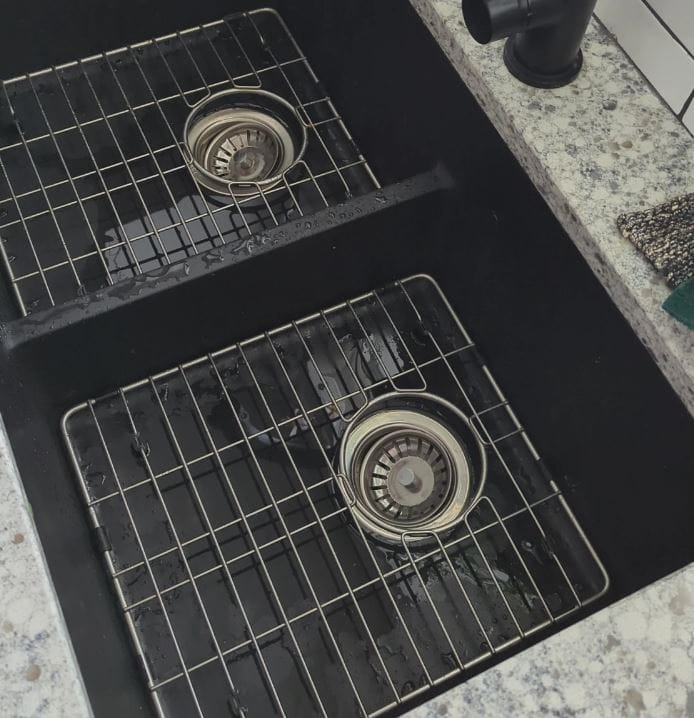
| Sink Grids (Stainless Steel) | Moderate (Protective) | A grid is a double-edged sword. A quality grid with soft feet protects the basin from impact. A cheap, unprotected grid can trap debris and create a micro-abrasion ring that matches its pattern. Choose coated grids. |
Maintenance Protocols to Prevent Micro-Marring
Scratch “prevention” on a PVD sink is largely about preventing micro-abrasion that dulls the finish over time. Following these protocols is essential for maintaining a pristine appearance:
- Rinse, Don’t Wipe a Dry Basin: Grit, salt, and minute ceramic dust from plates are the enemy. Always rinse the basin thoroughly before wiping it down to float away abrasive particles. Wiping a dry, gritty sink is like using fine sandpaper on the finish.
- The Soft Cloth Rule: Use only a soft microfiber cloth or a non-abrasive sponge. The “scratch” you see after cleaning is often a metal transfer from a scouring pad. ScrubDaddy sponges are generally considered safe for PVD finishes when the basin is wet.
- pH-Neutral is King: Stick to mild dish soap and water for daily cleaning. Aggressive alkaline (oven cleaners) or acidic (lime scale removers) chemicals can oxidize or etch even a high-quality finish over prolonged exposure.
- Address Water Quality Proactively: Hard water leaves mineral deposits that appear as cloudy white scuffs, often mistaken for scratches. Wipe the sink dry after use to prevent this and periodically use a mild white vinegar solution (on PVD only, never on coated) to dissolve mineral buildup, restoring the deep uniform black.
Restoration: A Critical Divergence
Here lies the final, non-negotiable argument for investing in a PVD sink.
Restoring a Coated Sink: It is generally impossible. There is no practical, in-situ repair for a scratched polymeric coating. Touch-up paints look amateurish, peel quickly, and are not food-safe. A single deep scratch on a coated sink is a permanent disfigurement.
Restoring a PVD Sink: Restoration is often possible. As mentioned, many “scratches” are actually metal transfers from pots, aluminum foil, or utensils. A specialist PVD cleaning cream or a gently used melamine foam sponge (Magic Eraser) can often remove these superficial marks by erasing the foreign material without attacking the colored layer. For an exceptionally light true scratch that has dulled the surface, a high-grade nano-polish can sometimes re-level the microscopic peaks of the PVD layer to restore its luster, though this is a task for a professional.
Conclusion: Choosing a Sink That Ages Gracefully
So, do black stainless steel sinks scratch? A premium, PVD-created black stainless steel sink is among the most scratch-resistant materials you can put in a kitchen, outperforming brushed nickel, standard stainless steel, and dramatically outperforming fireclay or composite granite in resistance to metallic marking and impact.
The question you should be asking is not “will it scratch?” but “when it is challenged, will the mark reveal a gleaming silver failure or remain a hidden, dark secret?”
- Invest in a PVD or proprietary nano-etched sink from a reputable manufacturer (e.g., Blanco, Franke, Kohler’s high-end lines). Insist on this specific terminology; avoid sinks merely described as “black stainless.”
- Accept no substitute. A budget-friendly coated sink in a high-traffic kitchen is a guaranteed future of visible, irreversible wear.
- Adopt a preservationist’s mindset. Use a protective grid, rinse away grit, and clean with a soft touch.
A properly manufactured black stainless steel sink does not simply scratch; it develops an almost imperceptible patina of use, all while maintaining its dramatic, monolithic beauty for a lifetime. The value is not in a surface that defies physics, but in a shield of color that is integral, deep, and relentlessly resilient.