Can You Use Dr. Bronner’s as Shampoo? A Detailed Guide to Castile Soap Hair Care
Yes, you can use Dr. Bronner’s Pure-Castile Soap as a shampoo, but it is not a direct, one-to-one replacement for conventional shampoo. Dr. Bronner’s itself acknowledges that its soaps can clean hair effectively, yet the process requires significant adjustment, dilution, and—most critically—an acidic rinse to counteract the soap’s high pH . Whether it works for you depends heavily on your hair type, water hardness, and willingness to troubleshoot.
Below is a structured breakdown of how to use it, what to expect, and how it compares to standard shampoo.
How Dr. Bronner’s Works on Hair (and Why pH Matters)
Dr. Bronner’s Pure-Castile Soap is a true soap made from saponified oils (typically coconut, palm, olive, hemp, and jojoba). True soap is alkaline, with a pH around 9, while human hair and scalp sit at a slightly acidic pH of roughly 5 to 6 .
This pH mismatch has two consequences:
- Cuticle disruption: The alkaline soap lifts the hair’s outer cuticle layer, which can leave hair feeling rough, tangly, or matted after washing .
- Mineral interaction: In hard water, the minerals in tap water react with soap to form soap scum, which can deposit a waxy residue on hair .
The solution is an acidic rinse after shampooing. Diluted apple cider vinegar or lemon juice helps flatten the cuticle back down, restoring softness and shine .
Step-by-Step: How to Wash Hair with Dr. Bronner’s
Dr. Bronner’s official guidance and customer-tested methods converge on a simple protocol:
- Wet hair thoroughly. The water in your hair provides enough dilution for the soap.
- Apply a small amount. Start with a dime-sized amount of liquid soap (or rub a bar soap directly onto very wet hair). There is no need to pre-dilute for a single wash, though some users prefer a 1:3 soap-to-water dilution for easier application .
- Massage into scalp and hair, then rinse completely.
- Follow with an acidic rinse. Dr. Bronner’s recommends its Organic Hair Rinse (lemon-juice based). A DIY substitute is 1 part apple cider vinegar to 1 part water, or 1 part lemon juice to 2 parts water (lemon juice is more acidic, so it needs more dilution) . Pour or spray through hair, massage for about 30 seconds, and rinse.
- Optional: Apply a light oil or Dr. Bronner’s Organic Hair Crème to ends if extra softness is needed.
Comparison: Dr. Bronner’s vs. Conventional Shampoo
| Feature | Dr. Bronner’s Pure-Castile Soap | Conventional Shampoo |
|---|---|---|
| Primary cleansing agent | Saponified oils (true soap) | Synthetic surfactants (e.g., sulfates or sulfate-free alternatives) |
| pH | Alkaline (~9) | Typically pH-balanced to hair (~4.5–5.5) |
| Effect on hair cuticle | Lifts cuticle; requires acidic rinse to close | Formulated to minimize cuticle disruption |
| Hard water performance | Poor; can leave waxy residue | Generally tolerant of hard water |
| Color-treated hair | Not recommended (can accelerate color fading) | Many are formulated to be color-safe |
| Transition period | Often 2–4 weeks of adjustment | None |
| Cost per wash | Very low (highly concentrated) | Varies; generally higher |
| Best for | Those seeking a minimalist, biodegradable, multi-use product; oily scalps; soft-water households | Those prioritizing predictable results, convenience, and hair-type-specific formulations |
Sources: Dr. Bronner’s UK , Dr. Bronner’s support , Beautycon , Wikipedia talk archive citing Dr. Bronner’s FAQ .
Which Dr. Bronner’s Product Works Best for Hair?
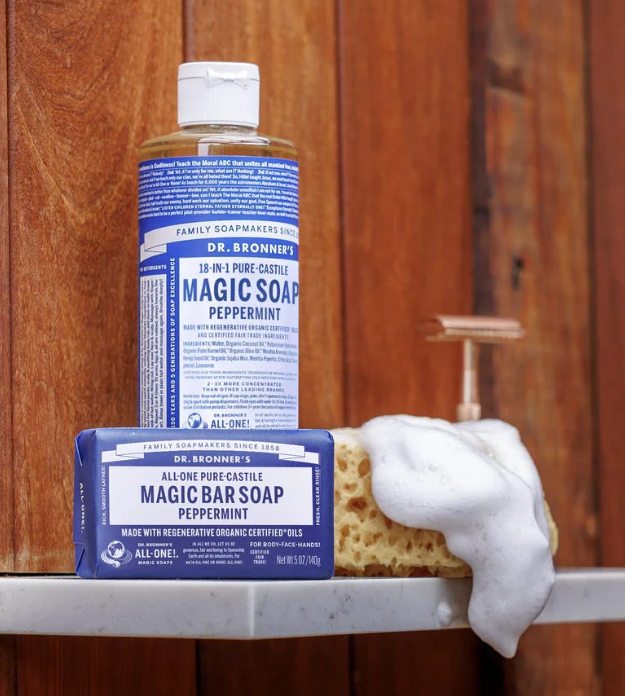
Dr. Bronner’s offers several formats, and the choice matters:
The Transition Period: What to Expect
If you are switching from a conventional shampoo (even a “natural” one), your hair will likely go through an adjustment phase lasting two to four weeks . Conventional shampoos and conditioners often leave behind silicones and waxes that coat the hair and create an artificial smoothness. When you stop using them, those coatings wash away, and your hair may initially feel:
- Greasier than normal in the first week or two
- Drier than normal after a couple of weeks as the scalp rebalances
Dr. Bronner’s describes this as a temporary trade-off that some users find leads to “the softest, silkiest hair they have ever experienced,” while others find their hair never adapts . Both outcomes are common and depend on individual hair biology.
Troubleshooting Common Problems
The Bottom Line
Dr. Bronner’s can function as a shampoo, but it is best understood as a high-alkaline cleanser that demands a pH-correcting follow-up. It excels for people who want a single, biodegradable product for body and hair, who have soft water, and who are willing to endure a transition period. It is a poor fit for color-treated hair, hard-water households without a filter, or anyone seeking predictable, low-effort hair care. Dr. Bronner’s itself frames hair-washing as something that “may involve a bit of tinkering to get it right”—and that is an honest summary of the experience .
Frequently Asked Questions (FAQ)
1. Do I have to use apple cider vinegar after washing with Dr. Bronner’s?
Yes, for most people. Dr. Bronner’s strongly recommends an acidic rinse after every shampoo because the soap’s alkaline pH lifts the hair cuticle, leaving it rough and tangly. Diluted apple cider vinegar (1:1 with water) or lemon juice (1:2 with water) closes the cuticle and restores softness . A small minority of users find they can skip this step, but if your hair feels straw-like, the rinse is the missing piece.
2. Can I use Dr. Bronner’s on color-treated hair?
No. Dr. Bronner’s support page explicitly states that its soaps are not recommended for color-treated hair. The alkaline pH can open the hair cuticle and cause dye to leach out more quickly, leading to fading and uneven color .
3. Should I dilute Dr. Bronner’s before putting it on my hair?
For a single wash, dilution is not required. Dr. Bronner’s instructions say to start with a dime-sized amount in your palm and apply to wet hair; the water in your hair provides sufficient dilution . However, if you are making a batch of DIY shampoo to keep in the shower, a 1:3 soap-to-water ratio is a common starting point, and any diluted batch should be used within two to four weeks because the product contains no synthetic preservatives .
4. Why does my hair feel waxy after using Dr. Bronner’s?
Hard water is the most likely culprit. The minerals in hard water react with true soap to form an insoluble residue that coats hair. Dr. Bronner’s reports that its bar soaps tend to perform better in hard water than the liquid version, possibly due to the salt content in the bar formulation . A shower filter or a final rinse with distilled water can also help.
5. Is Dr. Bronner’s better for my hair than regular shampoo?
“Better” depends on your priorities. Dr. Bronner’s is biodegradable, made with organic and fair-trade oils, and replaces multiple products with one bottle—advantages for environmental and minimalist concerns. However, conventional shampoos are engineered to be pH-appropriate for hair, tolerant of hard water, and predictable in results. Dr. Bronner’s requires more work and does not suit all hair types. If your goal is the lowest-effort path to consistently soft, manageable hair, a well-formulated conventional or sulfate-free shampoo will likely serve you better. If your goal is a simplified, natural routine and you are willing to troubleshoot, Dr. Bronner’s can work well.