Is It Safe to Use a Microwave with Rust Inside? The Unvarnished Truth
Article Summary
Opening your microwave door to find bubbling paint and reddish-brown rust spots is unsettling. The core question—“Is it safe?”—doesn’t have a simple yes or no answer. This article dissects the physics of microwave operation, the chemical nature of rust, and the critical difference between cosmetic damage and structural peril. We provide a definitive guide on when to scrub, when to repair, and when to recycle the appliance.
1. The Anatomy of the Problem: Why Is Your Microwave Rusting?
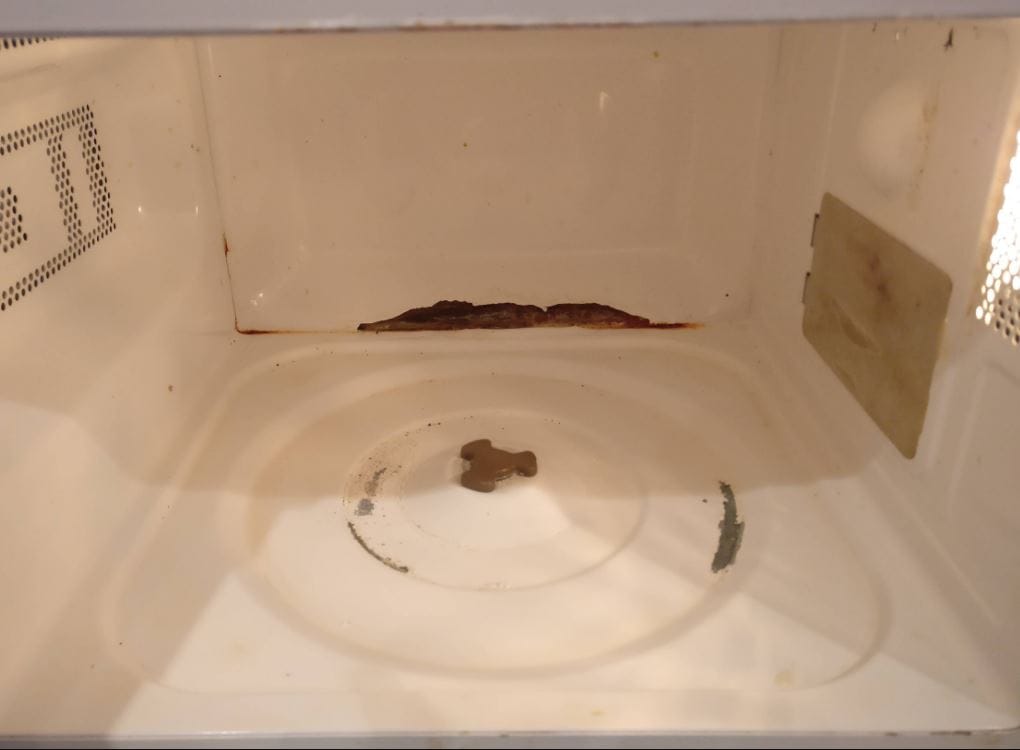
Before assessing safety, it’s crucial to understand why rust forms inside a microwave. Unlike a car fender, the interior of a microwave is not bare steel. It is coated with a specialized, non-porous enamel or epoxy paint. Rust appears when this protective barrier is compromised.
The Chain Reaction of Interior Decay
- Cleavage of the Coating: This typically starts with aggressive cleaning (steel wool) or a chip from a metal utensil sparking.
- Moisture Intrusion: Steam from cooking food penetrates the crack.
- Oxidation: The underlying metal (usually galvanized steel) is exposed to oxygen and water.
- Delamination: The rust expands, bubbling and peeling the surrounding paint like a cancer.
Common Problem Areas:
- The turntable well (pooling liquids).
- The interior ceiling directly above the waveguide cover (intense heat/food splatter).
- Door seams where the metal mesh meets the frame.
2. The Physics: Rust vs. Microwave Radiation
To understand the safety risk, we must separate fact from fiction. The primary danger of interior rust is not “radiation leakage” in the radioactive sense. It’s subtler than that.
The Faraday Cage Principle
A microwave oven is a Faraday cage. The mesh in the door and the solid metal walls are designed to contain electromagnetic waves at a frequency of 2.45 GHz. The interior coating is primarily an anti-corrosion and hygiene layer, not the primary shielding element.
Myth vs. Reality:
- Myth: Rust creates holes that let dangerous radiation pour out.
- Reality: Microwaves are non-ionizing radiation. If a hole does not compromise the structural thickness of the metal wall, the cage remains intact. However, rust on the door frame or mesh is a different story.
| Surface Type | Function | Consequence of Rust |
|---|---|---|
| Interior Cavity Wall | Food containment, reflection of waves, hygiene. | Arcing, smoke, and potential structural thinning if deep. Low radiation risk if solid. |
| Door Choke Groove | A quarter-wave channel that creates a seal to cancel escaping waves. | Critical danger. Distortion of the seal can cause measurable microwave leakage. |
| Metal Mesh Screen | Visual window while maintaining the Faraday cage. | High danger. Even pinholes larger than the mesh diameter (~1mm) can leak energy. |
| Waveguide Cover (Mica Plate) | Protects the magnetron from food splatter. | Arcing/burning. Not rust (mica doesn’t rust), but often confused with it. |
3. Safety Classification: A Damage Severity Index
Use this table to triage the condition of your microwave. Professional tone dictates we move beyond “surface rust” vs. “structural rust” and look at operational integrity.
| Classification | Visual Indicators | Operational Impact | Safety Verdict |
|---|---|---|---|
| Level 1: Superficial Pitting | Tiny pin-dots of orange under intact paint. No flaking. Feels smooth. | Negligible. Purely cosmetic oxidation bleeding through paint pores. | Safe to use. Monitor for progression. |
| Level 2: Active Delamination | Bubbled paint, flaking metal, orange powder accumulating on the turntable. | Potential for arcing (sparks) if flakes bend toward the wave pattern. | Unsafe for heating food. High fire risk from arcing. |
| Level 3: Cavity Perforation | A visible hole, or a soft spot that collapses under light pressure from a screwdriver. | Compromised Faraday cage. Steam enters the insulation blanket. | Immediate disposal required. |
| Level 4: Seam/Front Chassis Rust | Rust on the metal lip where the door meets the oven body. | Lifts the door alignment, breaking the choke seal. Leakage measurable on the sides. | Immediate disposal required. |
4. The Arcing Hazard: The Silent Destroyer
Beyond radiation anxiety, the immediate danger of interior rust is electrical arcing.
When a metal flake (rust) is exposed to high-frequency electromagnetic fields, it acts as an antenna. Charge builds up on the sharp points of the flake until it ionizes the air, creating a purple/blue lightning bolt inside your oven.
- Fire Risk: Arcing can ignite the remaining paint or accumulated grease.
- Magnetron Destruction: Reflected arcing energy can damage the magnetron’s antenna cap, destroying the appliance electronically even if the rust is later painted over.
5. The “Can I Just Paint Over It?” Conundrum
If you search DIY forums, you’ll find people sanding and repainting interiors. Is this professional-grade advice? Rarely.
The Hazards of DIY Repair
- VOCs and Food Safety: Standard spray paints emit toxic gases when heated and cannot contact food vapor.
- Dielectric Properties: Microwaves require coatings with specific loss tangents. A standard epoxy might absorb microwave energy, getting hot enough to melt or ignite.
- Waveguide Obstruction: Thick coatings applied poorly can alter standing wave patterns, causing dead spots or overheating.
The Only Acceptable Repair Path:
If the rust is purely in the dead center of a side wall (Level 2, no perforation), you can use FDA-compliant microwave cavity touch-up paint. This is a specific epoxy resin with high dielectric strength. The process requires sanding to bright metal, acetone cleaning, applying a micro-thin layer, and curing for 24 hours. Never paint the door seal or the waveguide cover.
6. The Food Contamination Variable
Assume a flake of rust fell into your soup. Is it toxic?
Ferric oxide (rust) is generally non-toxic in the trace amounts you would ingest. The FDA doesn’t classify it as a food additive, but incidental ingestion isn’t a poisoning emergency. The greater risk is the paint flakes containing titanium dioxide or other bonding agents mixed with the rust, which are definitively not food-grade. Eating from a rusted cavity lacks sanitary integrity, as the pitted surface harbors bacteria that microwave energy might not fully sanitize.
7. Economic Calculus: Repair vs. Replace
A microwave is not a vintage car. The economics of “fixing” rust rarely make sense.
| Factor | Cost to Repair | Rationale |
|---|---|---|
| Replacement Turntable/Mica | $10 – $25 | Worth fixing. |
| Cavity Touch-Up Paint Kit | $20 – $30 | Worth it only if the oven is a high-end built-in model ($500+). |
| New Door Assembly | $80 – $150 | Not worth it. Total loss for a countertop unit. |
| Professional Magnetron/Diode Fix | $150 – $250 | Economically nonsensical if the cavity is also rusted. |
| New Countertop Microwave | $80 – $200 | The safest, cheapest path for Level 3+ rust. |
8. The Final Verdict: When to Pull the Plug
Red Lines (Immediate Disposal):
- Door Frame Rust: Any rust on the metal face of the oven that contacts the door.
- Visible Perforation: Any pinprick of light or physical hole through the steel.
- Smell of Burning Metal: Indicates insulation is compromised or arcing is carbonizing the cavity.
Yellow Lines (Repair & Monitor):
- Isolated Interior Patch: A single rust spot smaller than a dime on the wall or floor, away from the door.
- Intact Mica Plate: The waveguide cover is clean, and the rust is purely on the oven body.
Green Light:
- You see what looks like rust but is actually a baked-on orange food stain (try a magic eraser sponge first).
Bottom line: The risk is less about acute radiation poisoning and more about fire dynamics and seal integrity. If the door doesn’t shut perfectly flush because of rust, the microwave is a paperweight.
Frequently Asked Questions (FAQ)
Q1: Can a little rust in a microwave cause radiation poisoning?
No. Microwave radiation is non-ionizing, meaning it cannot remove electrons from atoms or damage DNA. The risk of minor interior rust is leakage of thermal energy causing burns, or fire from arcing, not “radiation poisoning.”
Q2: Is it safe to eat food microwaved in a rusty oven if the food doesn’t touch the rust?
While the food might not physically touch the rust, the arcing created by rust flakes changes the cooking chemistry and can contaminate the air with carbonized paint smoke. Furthermore, the cavity is no longer sanitary. It is not recommended.
Q3: Can I cover the rust with a plate or wax paper?
No. Covering rust does not stop the metal from absorbing microwave energy and arcing. The electromagnetic fields pass through glass and paper, interacting directly with the corroded metal underneath.
Q4: Why does rust cause sparking, but the smooth metal walls don’t?
Smooth walls have low electrical resistance and reflect waves uniformly. Rust creates sharp, high-resistance points where electrical charge concentrates, exceeding the dielectric breakdown voltage of the air. This ionization is the spark you see.
Q5: Does lemon juice or vinegar remove microwave rust?
Acidic substances (lemon, vinegar) dissolve iron oxide. They might clean the orange stain temporarily, but they also accelerate the corrosion of the raw steel underneath and destroy the remaining enamel. Chemically, this makes the structural problem worse.
Q6: What is the black/brown burn mark on the mica plate if it isn’t rust?
The mica plate (the small gray cardboard-like square on the side wall) is a non-conductive cover. Marks on it are typically carbon scoring from food splatter absorbing energy and burning, or from the magnetron antenna arcing. It looks burned, not rusted. Replace it immediately.
Q7: How do I prevent rust from forming in a new microwave?
- Do not use steel wool or abrasive scouring pads.
- Cook with a microwave-safe splatter cover to minimize steam damage.
- Keep the door ajar after cooking to dry the cavity completely.
- Wipe spills immediately, especially acidic ones (tomato sauce), which eat the paint coating.