Cleaning Isn’t Just About Surfaces: Why Organisation Matters Just as Much
When people think about cleaning, the focus is usually visible. Wiping surfaces, vacuuming floors, polishing countertops, tasks that produce immediate, satisfying results. A clean home, in this sense, is one that looks tidy.
But appearance is only part of the picture.
A space can be spotless on the surface and still feel overwhelming underneath. Drawers filled with unused items, storage areas that haven’t been revisited in months, supplies that accumulate without purpose, these are the layers that traditional cleaning often misses. And yet, they have just as much influence on how a space functions and how it feels to live in.
This is where organisation becomes essential. Not as a separate task, but as a natural extension of cleaning itself.
The Difference Between Clean and Clear
A clean space removes dirt. A clear space removes friction.
You can clean a kitchen thoroughly, but if every cabinet is overfilled or disorganised, using that space will still feel difficult. The same applies to home offices, storage rooms, and even living areas. When items are not arranged intentionally, they create small, ongoing inconveniences that build over time.
Organisation addresses this by focusing on how a space is used, not just how it looks.
It asks practical questions: What do I actually need here? What is being stored out of habit rather than purpose? What is taking up space without adding value?
These questions often reveal that clutter is not always visible. It hides in the margins of everyday life.
The Build-Up We Don’t Notice
Clutter rarely arrives all at once. It accumulates gradually, through small decisions that don’t seem significant at the time.
A stack of materials from a past project. Supplies kept “just in case.” Items that were useful once but haven’t been touched since. Over time, these begin to occupy space without contributing to how the space functions.
Work-related materials are a common example. Presentation boards, packaging supplies, or leftover prints often remain stored long after they’re needed. In some cases, items like those created through foam board printing are essential for short-term use but can become bulky and impractical to store once their purpose has passed.
The challenge is not having these items, it’s holding onto them longer than necessary.
Why Letting Go Is Part of Cleaning
One of the most overlooked aspects of maintaining a clean home is knowing what to remove.
Cleaning tends to focus on maintaining what is already there. Organisation, on the other hand, requires a different mindset. It involves evaluating whether something still deserves space.
This is not about minimalism or reducing everything to the essentials. It is about alignment, ensuring that what you keep supports how you live now, not how you lived months or years ago.
Office supplies are a good example. It’s easy to store unused items indefinitely, especially when they seem potentially useful. But in reality, many of these items can be repurposed, recycled, or even resold. Platforms such as selltoner.com make it possible to move unused toner and similar supplies back into circulation, turning what would otherwise sit in storage into something functional again.
Letting go, in this sense, is not wasteful. It is practical.
What Research Suggests About Clutter and Wellbeing
The impact of clutter goes beyond physical space. It also affects how we think and feel within that space.
According to Harvard Health Publishing, cluttered environments can contribute to increased stress levels and reduced ability to focus. When the brain is constantly processing visual and spatial information, it becomes harder to maintain clarity and concentration.
This is why organisation matters as much as cleaning. It creates an environment that supports both physical comfort and mental ease.
A well-organised space reduces unnecessary stimuli. It allows attention to be directed where it is needed, rather than scattered across multiple distractions.
Creating Systems Instead of One-Time Fixes
One of the reasons clutter returns is that cleaning is often approached as a one-time effort.
A deep clean can restore order temporarily, but without systems in place, the same patterns tend to repeat. Items accumulate, spaces become crowded, and the cycle starts again.
Organisation works differently. It focuses on creating systems that maintain clarity over time.
This might include designated storage for frequently used items, regular check-ins for less-used areas, or simple rules about what gets kept and what doesn’t. These systems don’t need to be complex. In fact, the simpler they are, the more likely they are to last.
The goal is not perfection. It is consistency.
The Role of Awareness in Everyday Spaces
Perhaps the most important shift is becoming more aware of how a space is used.
Instead of treating cleaning as a separate task, it becomes part of a broader awareness of how your environment supports your daily life. You begin to notice when something feels crowded, when storage stops working, or when items start to accumulate without purpose.
This awareness makes it easier to take action early, before clutter becomes overwhelming.
It also changes how new items are introduced into the space. Decisions become more intentional. Instead of adding something automatically, there is a moment of consideration, where will this go, and does it truly belong here?
A More Complete Approach to Clean Living
When cleaning and organisation are treated as separate activities, it is easy to focus on one and neglect the other. But when they are combined, they create a more complete approach to maintaining a space.
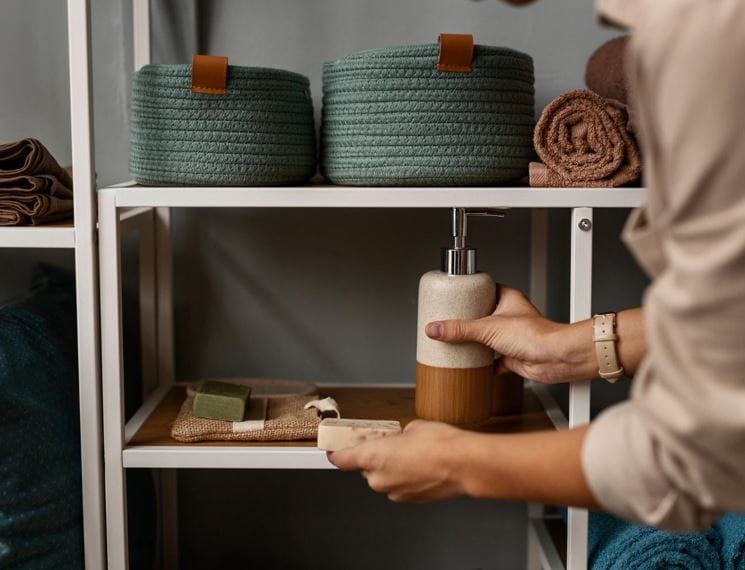
Cleaning maintains the condition of what is present. Organisation ensures that what is present actually belongs.
Together, they create spaces that are not only tidy, but functional, efficient, and easier to live in.
Why It Matters More Than It Seems
A well-organised space does more than look good. It changes how a space feels and how it works.
Tasks become easier. Movement becomes more natural. There is less friction in everyday routines. And perhaps most importantly, there is a sense of calm that comes from knowing that everything has a place, and a purpose.
In the end, cleaning is not just about what we remove from surfaces. It is about what we choose to keep, what we choose to let go of, and how those decisions shape the spaces we live in every day.